Free template
Free 12-month cash flow forecast template
Runway · September 2026 · General information, not financial advice
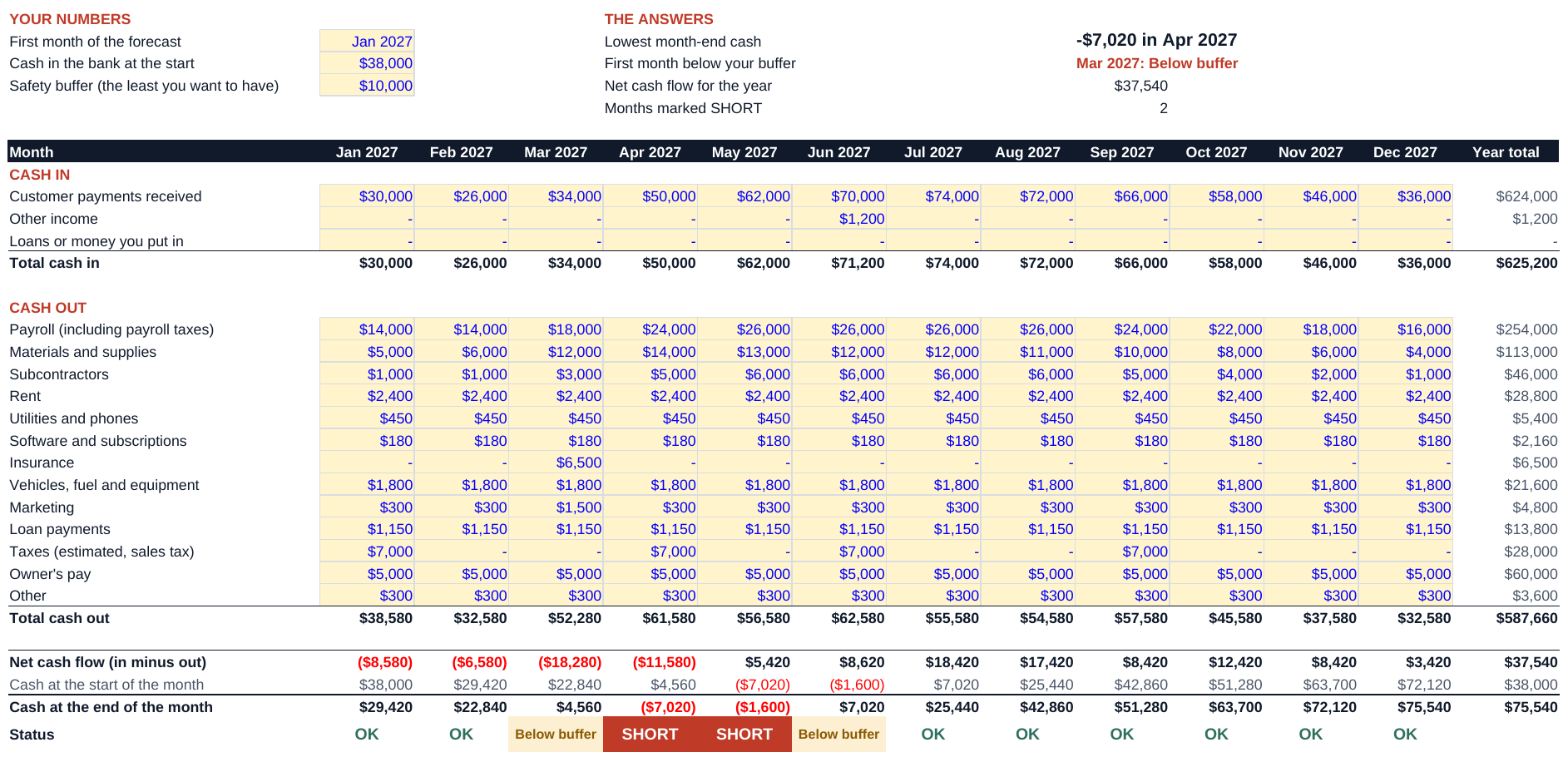
Plan the year month by month: the seasons, the big annual bills, and the months your cash gets tight. Below you'll find the free template, how to fill it in, and when a 12-week forecast is the better tool.
Free, no signup. It's an Excel file; you can also upload it to Google Drive and open it with Google Sheets.
12 months or 12 weeks? They answer different questions
| 12-month forecast | 12-week forecast |
|---|
| Looks at | The whole year, month by month | The next three months, week by week |
| Answers | Will the year work? Which months get tight? | Which week do I run short? What's safe to spend now? |
| Best for | Business plans, lenders, seasonal businesses, annual budgets | Payroll timing, slow-paying clients, materials paid up front |
| Update it | Monthly | Weekly |
| Can miss | A bad week inside a good month | Anything past three months |
Most businesses that feel the squeeze use both: the 12-month view for the shape of the year, and a 12-week view for the next few months in detail.
How to fill in the 12-month template
- Type the first month of your forecast, the cash you have at the start, and your safety buffer: the least you ever want to have.
- Enter money in the month it actually reaches your bank account, not the month you invoice. If a client pays 60 days after the job, put it two months later.
- Enter bills in the month you pay them.
- Put annual and quarterly bills, like insurance and estimated taxes, in the exact month they're due.
- Read the answers at the top: your lowest month, the first month you drop below your buffer, and your net for the year.
Common mistakes
- Counting invoices as cash. A forecast full of invoice dates looks healthier than your bank account will.
- Averaging a seasonal year. If winter is slow, a flat monthly average hides the months that hurt. Use the real months.
- Forgetting the big once-a-year bills. Insurance renewals and quarterly taxes are exactly what turn a tight month into a short one.
- No buffer. Ending a month at $200 is not "fine." Pick a minimum and treat anything under it as a warning.
When the 12-month view isn't enough
A month is a long time. In the example, March ends at $4,560, which looks survivable. But payroll goes out every week, and if a big client payment lands on the 28th, there can be a week in the middle of the month when the account is well below that.
If your cash is tight week to week, add a 12-week forecast for the next few months. It plans each invoice for when that client actually tends to pay, sets money aside weekly for big bills, and shows the first week you'd run short.
Both templates are free
Use the 12-month template for the shape of your year, and the 12-week template for the weeks that can actually hurt you.
Related guides: How to forecast cash flow when clients pay 30 to 90 days later · What to do when a client pays late